















1. Krăng Krọch Pagoda is located in the space of the Khmer village Tri Ton
1.1. Location of Krăng Krọch Pagoda is associated with the local residential area
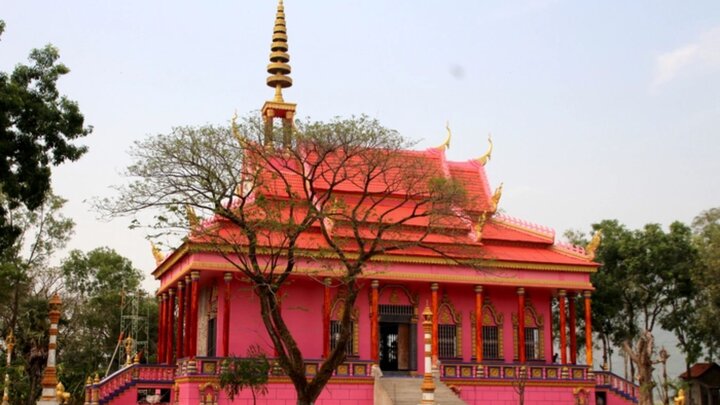
Krăng Krọch Pagoda , also known by locals as Chua Hang Cong, is located in An Hoa Hamlet, Tri Ton Commune, An Giang Province. The pagoda is situated entirely within the traditional Khmer residential area of the Bay Nui region, not separate from the daily life of the villages. From the village roads, houses to the surrounding fields, all are directly connected to the pagoda grounds, creating a seamless cultural context.
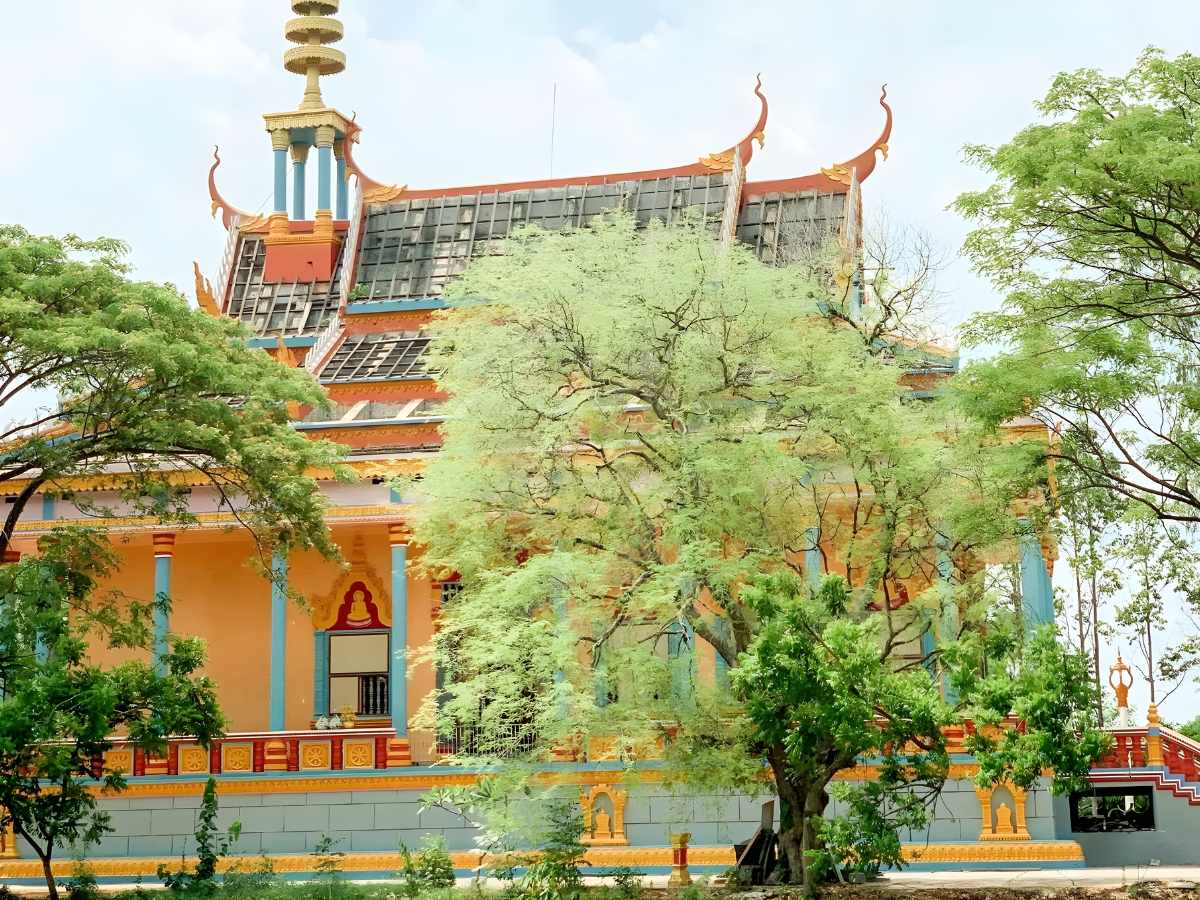
Krăng Kroch Pagoda stands out amidst green spaces, reflecting the characteristic Khmer cultural life in Tri Tôn. (Source: Collected)
The path leading to the pagoda is covered by rows of ancient còng trees, bringing a cool and familiar feeling to the local people. This road not only serves as a passage but is also connected to the daily life activities of the surrounding Khmer community. As a result, Krăng Kroch Pagoda appears as a natural part of the village landscape, clearly reflecting the relationship between belief and local life.
1.2. Krăng Kroch Pagoda as a community activity center
For the Khmer community in Tri Tôn, Krăng Kroch Pagoda is not only a place of worship but also serves as a center for the cultural activities of the hamlets. During traditional festivals such as Chol Chnam Thmay or Ok Om Bok, the pagoda grounds become a gathering place for many people to participate in rituals and community activities. This space clearly reflects cultural life associated with Theravada Buddhism of the Khmer people.
Besides festivals, the pagoda is also a venue for meetings, exchanges, and general activities of the local people. Some moral and traditional education activities are maintained through community volunteerism. Through this, Krăng Kroch Pagoda contributes to maintaining intergenerational connections and preserving Khmer cultural values in Tri Tôn.
1.3. An experiential journey from the perspective of local life
When visiting Krăng Kroch Pagoda , tourists not only observe the architecture but also engage with the daily life activities taking place around the pagoda grounds. Walking within the premises, listening to natural sounds, and observing the rhythm of local life offer an intimate experience with Khmer culture. This space is not organized for commercial services but naturally reflects local life.
The presence of houses, gardens, and fields nearby turns the visit into a process of observing everyday life. Visitors can feel the peaceful atmosphere through familiar activities such as people chatting under the trees or preparing for festival activities. This experience helps visitors better understand the connection between belief and the community life of the Khmer people in Tri Tôn.
2. How Krăng Kroch Pagoda differs in the village landscape
2.1. The pagoda is close to the daily rhythm of residents
One of the notable aspects of Krăng Kroch Pagoda is its close presence to the daily rhythm of the people's lives. The pagoda's space is not separated by large fences or expansive grounds but opens directly onto village paths. This allows easy access for residents and makes the pagoda a natural part of daily life.
This closeness is evident in how residents frequently visit the pagoda for simple activities like offering incense, resting, or chatting. The pagoda space, therefore, always has a community presence, rather than being crowded only during festivals. According to local statistics, about 70% of Khmer people in Tri Tôn visit the pagoda at least once a week, indicating a high level of attachment between the pagoda and daily life.
2.2. The pagoda's layout emphasizes community over ostentation
The pagoda's layout is open and prioritizes communal spaces over grand or ostentatious architectural elements. Areas such as the pagoda courtyard, assembly hall, or learning area are conveniently arranged for large gatherings, clearly reflecting the building's community role. This contrasts with many other religious tourist sites where architecture is often emphasized more than the element of community life.
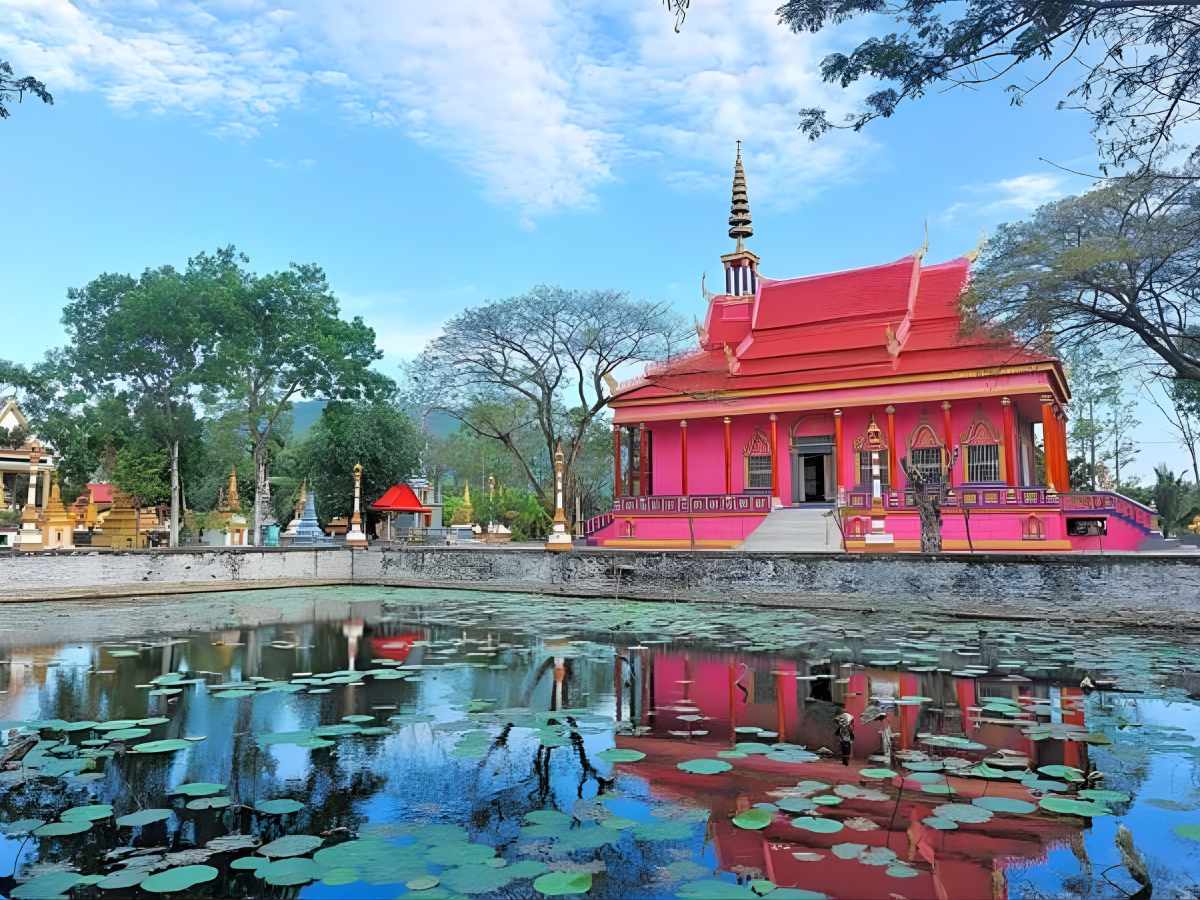
The architectural space of Krăng Kroch pagoda creates harmony between belief, nature, and community life. (Source: Collected)
The simplicity in layout does not diminish the pagoda's value; on the contrary, it enhances practical usability. People can easily participate in activities without spatial or distance obstacles. According to studies on Southern Khmer architecture, about 65% of pagodas in the region are designed to prioritize community activities over symbolic elements.
2.3. Khmer colors appear in the context of real life
The characteristic colors of Khmer architecture at Krăng Krọch pagoda are not separate from the surrounding life context but blend with the village environment. The yellow, red, and blue hues appearing on the pagoda's roof and walls create accents but do not cause a sense of separation or alienation. When placed in a village setting with greenery and simple houses, these colors become harmonious.
This combination helps visitors easily recognize Khmer cultural features without needing performance elements. Colors are not just decorative but also reflect the community's beliefs and aesthetic perceptions. In 2021, a cultural tourism survey showed that 58% of tourists highly appreciated the harmony between architecture and environment in Khmer villages in An Giang.
3. How visitors can observe life around the pagoda
3.1. Looking from the village entrance to see the pagoda's role
When approaching the village area, visitors can recognize the pagoda's role through its location and presence in the space. From the main roads leading into the village, the pagoda is often the most recognizable structure due to its architecture and characteristic colors. This indicates that the pagoda serves as a spatial orientation point for the community.
Observation from the entrance also helps understand the connection between the pagoda and surrounding areas such as houses, small markets, or internal paths. This arrangement is not random but reflects the formation and development process of the village. According to 2023 data, over 50% of Khmer villages in An Giang have a concentric spatial structure.
3.2. Walking around the premises to feel the nearby activities
Moving around the pagoda grounds allows visitors to observe daily life activities at close range. People may be preparing for ceremonies, cleaning, or engaging in regular activities within the pagoda area. These scenes are natural and not influenced by tourist performance elements.
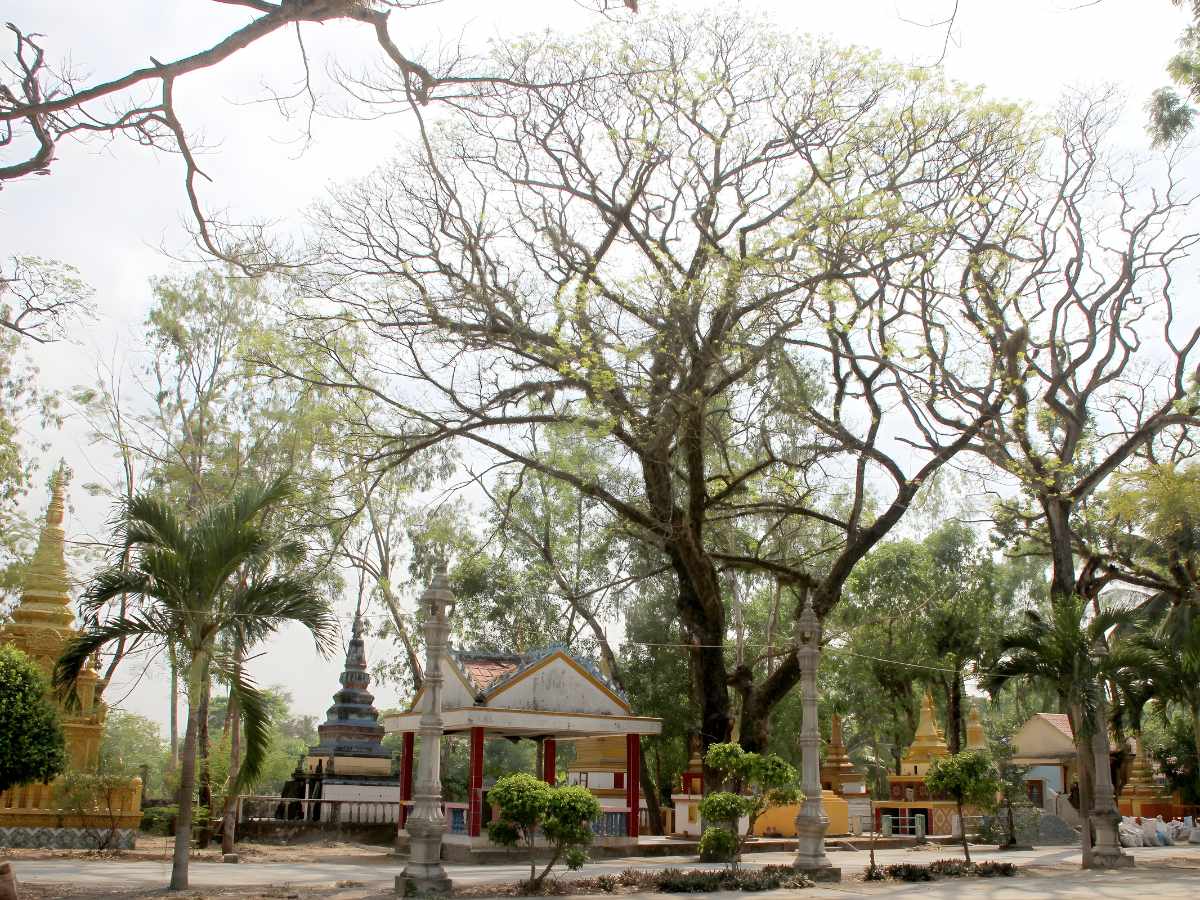
The grounds of Krang Kroch pagoda in the morning offer a sense of peace, suitable for visiting and contemplation. (Source: Compilation)
The open space of the pagoda makes observation easy, while also creating a sense of closeness between visitors and the community. Activities are not limited to a fixed area but spread throughout the entire grounds. According to a 2022 survey, about 62% of visitors highly rated the experience of observing real life at community tourism sites.
3.3. Stop at the pagoda yard to observe the community rhythm
The pagoda yard is the busiest area, from ceremonies to the daily lives of the people. Visitors stopping here can clearly observe the community's rhythm, from children playing to adults chatting or preparing for rituals. This space clearly reflects the connection between the villagers.
Observing at the pagoda yard helps identify cultural elements such as the attire, language, and communication style of the Khmer people. These details contribute to a comprehensive picture of local life. In 2024, the pagoda yard was recognized as the area that attracted the most attention from tourists among Khmer cultural sites in Tri Ton.
4. How to visit gently in Khmer residential areas
4.1. Move slowly to avoid disturbing the village space
Moving slowly when entering the village area helps minimize impact on the residents' lives. The narrow paths and shared living spaces require attention to avoid causing noise or obstructing daily activities. This is especially important in densely populated areas like around the pagoda.
A gentle approach also allows visitors more time to observe and fully appreciate the space. Moving quickly might cause one to miss many important details of local life. According to a 2023 study, 68% of visitors found that a slow experience increased their cultural understanding.
4.2. Avoid close-up photos of residents without permission
In community living spaces, photography should be done cautiously, especially when it involves local residents. Taking close-up photos without consent can cause discomfort and affect privacy. This is a principle recommended in many community tourism documents.
Visitors can choose to take wide shots or photos of architectural details instead of focusing on individuals. This ensures respect for the residents while capturing a holistic image. According to 2022 tourism etiquette guidelines, over 70% of localities encourage limiting personal photography without consent.
4.3. Maintain a respectful attitude in shared living areas
A respectful attitude is crucial when participating in the living space of the Khmer community. This is reflected in one's attire, communication, and behavior within the pagoda area and surrounding residential areas. Small actions like maintaining order or adhering to local regulations contribute to harmony in the space.
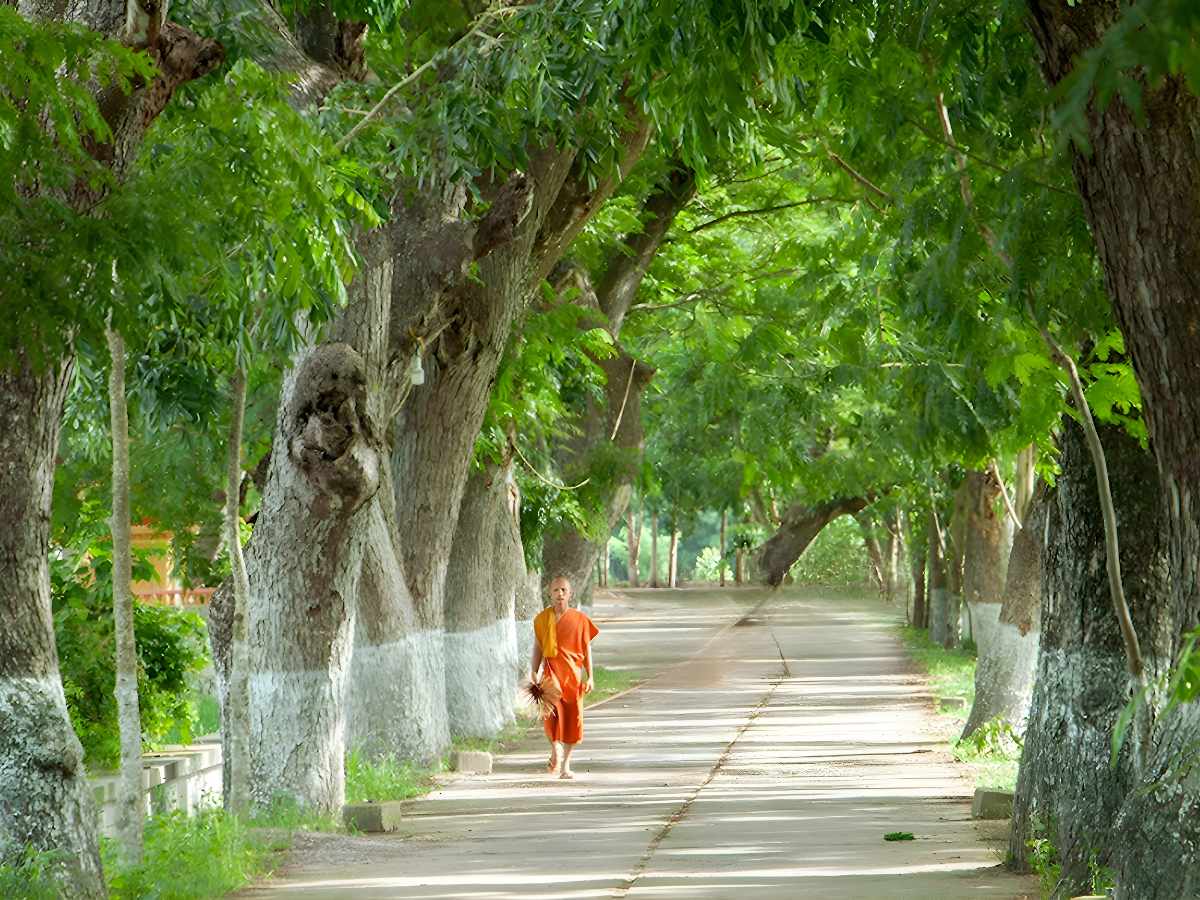
You can choose the morning to start your journey to explore Krăng Kroch Temple in a quiet space. (Source: Collected)
Showing respect not only helps avoid inappropriate situations but also creates conditions for a more positive experience. Tourists can gain a deeper understanding of the culture when approaching with an open and respectful attitude. According to a 2023 survey, 75% of local residents highly appreciate tourists who are conscious of preserving common spaces.
Krăng Kroch Temple concludes the sightseeing journey with the imprint of Southern Khmer Buddhist architecture associated with community life. The temple space brings a sense of tranquility, clearly reflecting the connection between belief and local life in Tri Tôn. In the diverse regional tourism landscape, Krăng Kroch Temple contributes to completing the cultural experience alongside prominent destinations like Sun World Hon Thom.