















Progress Update on the Phu Quoc International Airport Expansion Project to Serve APEC 2027
With only 9 months of construction, the Phu Quoc International Airport expansion investment project, with a total investment of VND 22,000 billion, is gradually completing its infrastructure and preparing for operation according to international standards.
Constructed under difficult conditions of weak soil and alongside the still-operational runway 1, runway number 2 has achieved a cement concrete progress of about 58% for the base layer, while the high-quality concrete layer has begun construction just 4 months after embankment. It is expected that the 3,300m long runway will be completed by June 30, 2026.
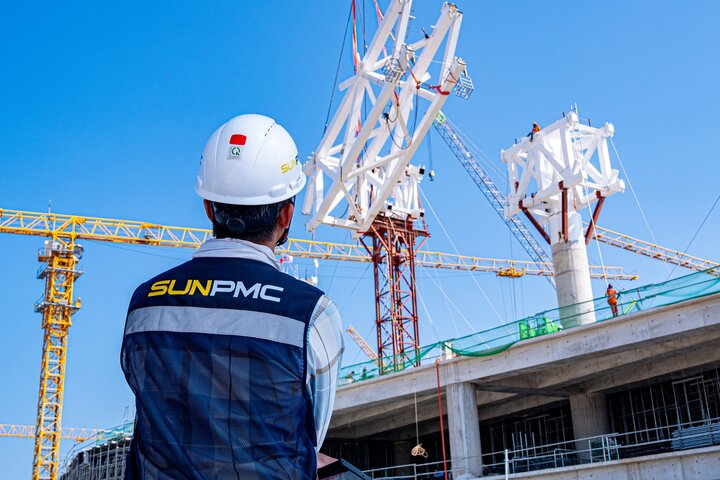
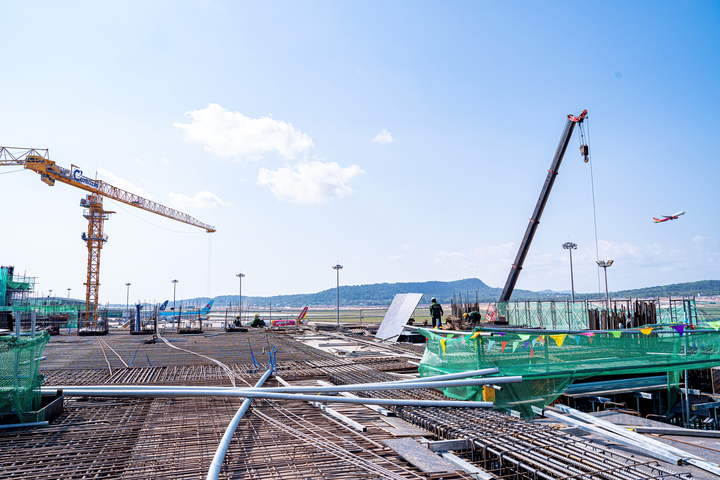
The expansion project of Phu Quoc International Airport is being constructed at breakneck speed
To meet ICAO 4E standards, every detail on the runway must be calculated for wide-body aircraft such as Boeing 787, Airbus A350-900,...: from the 78cm thick cement concrete layer capable of withstanding a tire pressure of up to 1.71 MPa, to aircraft loads of up to 400 tons.
At passenger terminal T2, the structural work has reached about 85% and officially entered the phase of installing the roof steel structure from early March 2026, a significant milestone to shape the future architectural space of the terminal. Passenger terminal T2 of the airport was designed by CPG Consultants (Singapore) and Artelia Airport (France), inspired by the image of the Fire Phoenix, symbolizing strength and rebirth, embodying Vietnam's aspirations in the new era.
Notably, the VIP terminal, a facility serving heads of state and high-level guests, has completed 100% of its rough structure, with the roof structure at about 60%, indicating construction progress exceeding expectations and rapidly moving towards the finishing stage.
Aircraft parking apron items are also being implemented at high speed, with some areas fully completed, laying the foundation for enhanced operational capacity in the future.
Phu Quoc International Airport will synchronously apply a series of world-leading aviation technologies, including the Total Airport Management (TAM) model, biometric systems for a seamless, touchless journey, the ICS modern baggage handling system, along with automated parking, underground refueling, and remote-controlled jet bridges, aiming to become a leading smart airport in the region, while reducing check-in time to just 15-20 seconds per person.
The superior progress of the Phu Quoc International Airport expansion project not only demonstrates the efforts of Sun Group but also reflects the local authorities' determination to make Phu Quoc a regional destination. As key components are completed one by one, the new image of a world-leading modern airport is gradually taking shape, creating a crucial foundation for the "Pearl Island" to be ready for APEC 2027.
How will Phu Quoc International Airport be "world-class" after its upgrade?
Phu Quoc International Airport is undergoing a large-scale upgrade to become one of the most modern airports in the world, directly serving preparations for APEC 2027 and acting as a "gateway" to elevate Phu Quoc's status on the international map. The project is invested by Sun Group, with the participation of CPG Singapore – the entity behind the design of Changi Airport (Singapore) and French aviation consultant Artelia Airport. Upon completion, the airport will be operated with direct consultation from Changi Airport Group (CAG), Singapore's renowned airport management corporation.
The total investment for the expansion project is nearly VND 22,000 billion. According to the approved plan, the airport will meet ICAO's 4E standards, qualifying it to receive wide-body aircraft such as Boeing 747, Boeing 787, or Airbus A350. The project spans an area of 1,050 hectares, and upon operation, will increase capacity to 20 million passengers per year, approximately 4.5 times the current capacity.

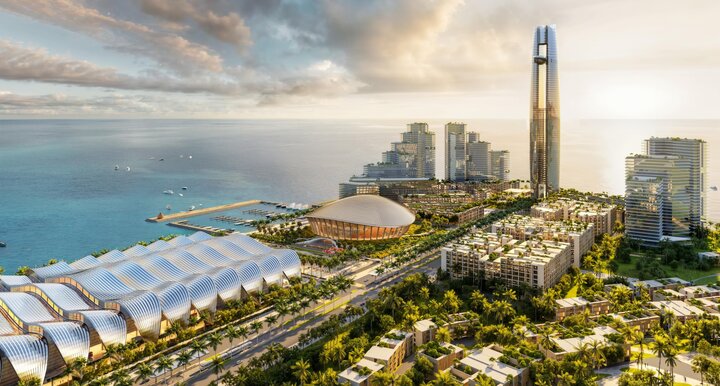
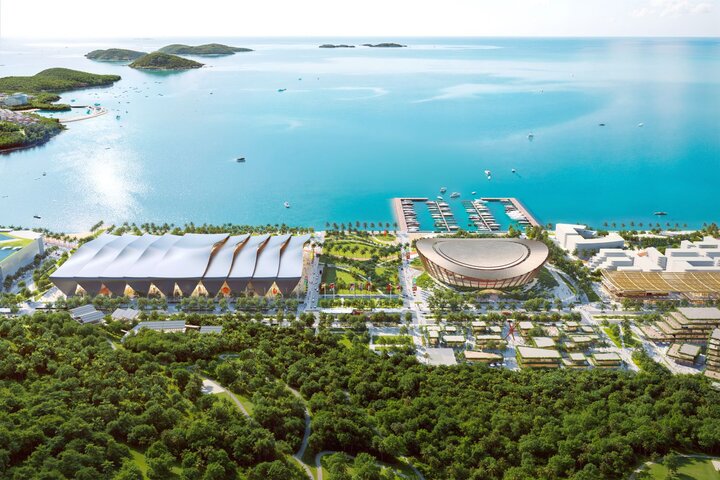
Model of a world-leading modern passenger terminal. (Photo: Sun Group)
The runway infrastructure includes the expansion of the current runway 1 and the construction of a new runway 2, with lengths of 3,500 m and 3,300 m respectively. The apron system will be expanded to over 120 parking positions, with up to 71 positions directly connected to modern jet bridges.
Passenger terminal T2 is designed with inspiration from the image of the Fire Phoenix bird – a symbol of strength and rebirth. The VIP terminal has a construction area of 6,000m2, designed by Italian architect Marco Casamonti - the "father" of the Kiss Bridge icon in Phu Quoc, inspired by the image of the sea eagle – a symbol of freedom, flexibility, and harmony with nature. The VIP terminal will host heads of state during APEC 2027 and important events in Phu Quoc in the future.

Passenger Terminal T2 was designed inspired by the image of the Fire Phoenix bird. Photo: Sun Group