















Gia Long Mausoleum, located in An Thoi commune, was built in the traditional architectural style of ancient Vietnamese people. Exploring the mausoleum not only helps visitors understand more about the history of Phu Quoc Pearl Island but also demonstrates respect for national heritage and historical sites.
The Footprints of Emperor Gia Long
In mid-1783, the Tay Son army continued their southern advance, attacking Nguyen Anh. The Tay Son forces were very strong at this time, and Nguyen Anh had to flee across almost all the southern waterways. However, wherever he went, he was pursued by the Tay Son army.
In desperation, Nguyen Anh and his remaining troops had to flee to Phu Quoc Island. It was this island that harbored him, allowing him to return to the mainland later, gather his forces, defeat the Tay Son, and ascend the throne as Emperor in 1802.
Legend has it that during one escape from the Tay Son rebels, Nguyen Anh, along with his wife, children, and soldiers, had to flee to the Ong Doi Cape area on Phu Quoc Island. This is a large mountain range extending into the sea, facing east, with a rather rugged terrain. However, by the time they arrived, their food supplies were depleted, and the wild vegetables they gathered were not enough to feed the army. The situation was extremely difficult; if they moved elsewhere, they would be intercepted by the Tay Son rebels.
While the soldiers' morale wavered and Nguyen Anh was in distress, he stomped his foot, plunged his sword into the ground, and looked up at the sky, exclaiming: "If heaven grants me to be king, then grant me fresh water and food." After his lament, fresh water suddenly gushed from where the sword was plunged. And fish from the sea suddenly swarmed, darkening the waters around Ong Doi Cape. The fresh water and fish helped Lord Nguyen and his soldiers overcome their dire situation. This type of fish was subsequently named Ca Com (Anchovy).
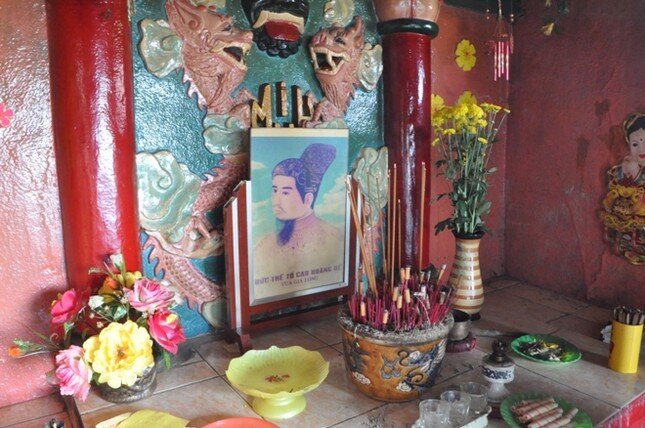
Ong Doi Cape is now part of An Thoi town, located near the base of Naval Region 5. It boasts a beautiful strait with crystal-clear waters and fine sand. Many large tourism projects are currently being invested in and developed. Visitors come to Ong Doi Cape to take photos at the spot where Nguyen Anh – Gia Long's footprints are imprinted, and to drink the miraculously fresh water from Gieng Tien (Fairy Well). Many superstitious people believe the well water has healing properties. There is also a stone "Throne" weighing several tons, facing east. The temple dedicated to "Duc The To Cao Hoang De Vua Gia Long" (Venerable Ancestor High Emperor King Gia Long) still emanates incense smoke day and night. The sea area of Ong Doi Cape is also a place where tourists can enjoy swimming, snorkeling, and fishing.
The Last Battle of Nguyen Trung Truc
Another famous historical figure – National Hero Nguyen Trung Truc (1839-1868), a leader of the anti-French movement in the southern region in the latter half of the 19th century, also had to flee to Phu Quoc Island when in danger.
In the early morning of June 16, 1868, Nguyen Trung Truc's rebels unexpectedly attacked the Kien Giang fort (now the area where the Kien Giang Provincial People's Committee is located), killing 5 French officers and 67 soldiers, and capturing many weapons and ammunition. However, after this victory, a few days later, the French command in My Tho dispatched forces to counterattack. Due to the overwhelming enemy strength, Nguyen Trung Truc had to retreat to Hon Chong (Kien Luong) and then cross the sea to Phu Quoc Island, stationing his troops in the forest area of Cua Can commune.
By September 1868, the French continued to deploy a large force to Phu Quoc Island to pursue Nguyen Trung Truc's rebels. The rebels fiercely resisted for months on end on the island. After capturing Nguyen Trung Truc, on October 27, 1868, the French authorities executed him at Rach Gia market. Before his sacrifice, he composed a poem and resolutely declared: "Only when the West eradicates all grass in the South, will the Southern people stop fighting the West."
After Nguyen Trung Truc's death, temples dedicated to this heroic national hero sprang up in almost all provinces in the West. At the temple in the forest area of Hamlet 2, Cua Can Commune (Phu Quoc), the locals also built a long house to preserve Nguyen Trung Truc's war boat. Artifacts of the rebels are also displayed in prominent positions at the Coi Nguon Museum on Phu Quoc Island.
Near the mouth of the Cua Can river is the tomb of Ba Tuong Lon (Madam Tuong Lon), the wife of the divine general Nguyen Trung Truc, which is also revered and looked after by the locals day and night. The islanders of Phu Quoc still pass down the story that: Nguyen Trung Truc's wife gave birth but lacked milk for her baby. Upon learning this, the French ordered that anyone who breastfed Nguyen Trung Truc's child would be exterminated for three generations. Fearing this, the villagers in Cua Can dared not offer milk. When she went to ask for milk from the entire village and no one would help, Nguyen Trung Truc's wife took a boat across the sea to the mainland to save her child, but the boat ran aground, and both mother and child perished. The place name Cua Can originated from this event.
After Madam Tuong Lon's death, in Cua Can commune, any child born could not be raised. The locals rumored that Madam Tuong Lon resented people, so she took away any child born. For the people of Cua Can to raise their children, they had to give birth elsewhere and only bring them home after the breastfeeding period. Madam Tuong Lon's tomb was found on April 27, 1963, in the Dong Ba area, Hamlet 3, Cua Can Commune. Every year, on the 18th and 19th days of the 8th lunar month, the locals organize a memorial ceremony to honor her.
Inside the temple of Emperor Gia Long at Ong Doi Cape:
Footprints of Nguyen Anh – Gia Long on the rock
The "Throne" where Nguyen Anh – Gia Long sat
The temple of Nguyen Anh – Gia Long
Ong Doi Cape viewed from afar
Statue of national hero Nguyen Trung Truc in Hamlet 2, Cua Can Commune
The tomb of Madam Tuong Lon